
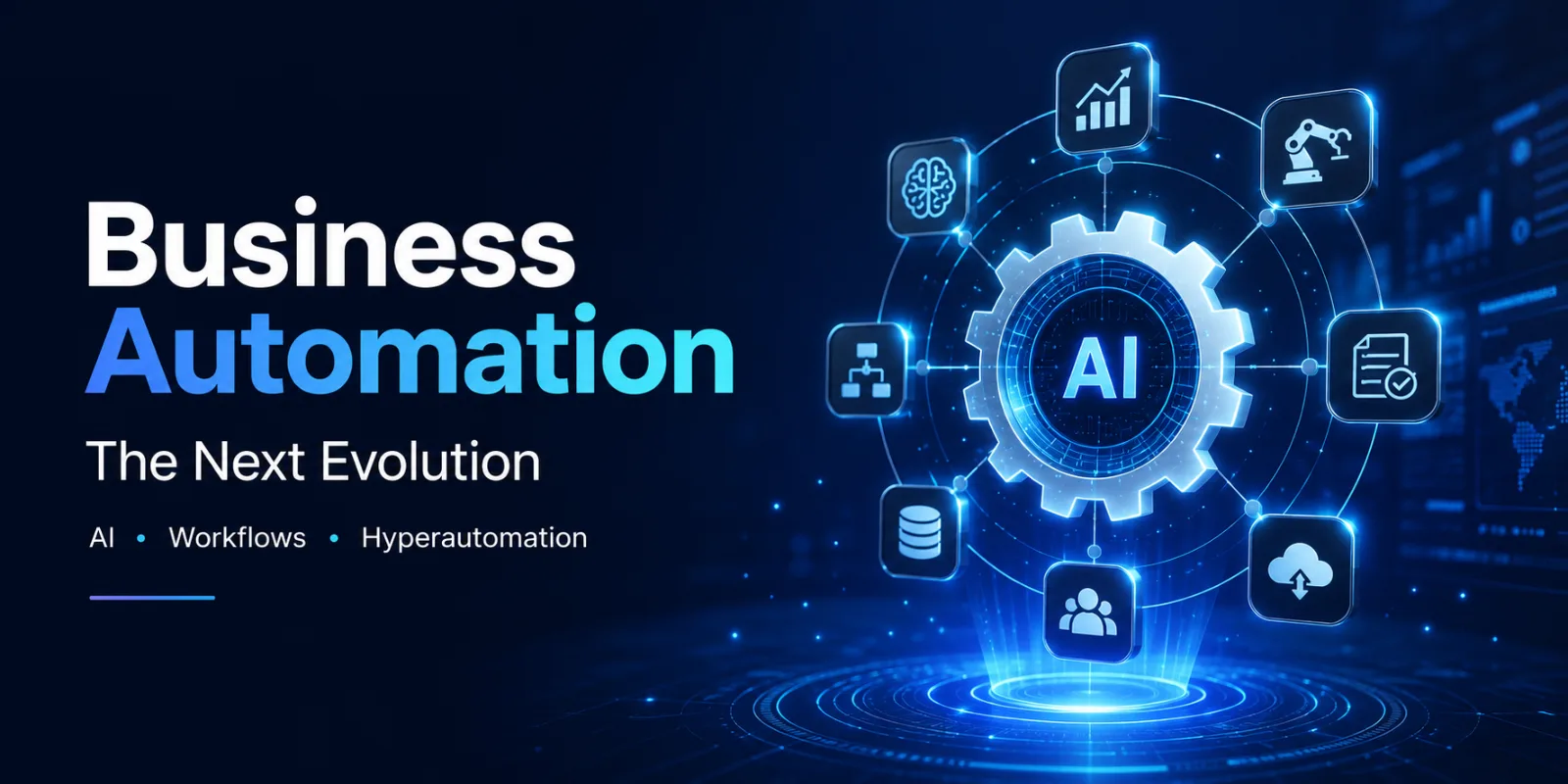
Discover how AI, intelligent workflows, machine learning, and hyperautomation are transforming business operations. Learn how modern automation improves productivity, reduces costs, and accelerates digital transformation.
Business automation has entered a new era. What once involved simple rule-based workflows has evolved into intelligent systems capable of learning, adapting, and making data-driven decisions. Powered by Artificial Intelligence (AI), Machine Learning (ML), Robotic Process Automation (RPA), and cloud technologies, modern automation is helping organizations streamline operations, reduce costs, and deliver exceptional customer experiences.
Today's businesses face increasing competition, rising customer expectations, and the need to do more with fewer resources. Intelligent automation addresses these challenges by eliminating repetitive work, accelerating decision-making, and enabling employees to focus on strategic initiatives.
Whether you're a startup, an SMB, or a large enterprise, understanding the next evolution of business automation is essential for staying competitive in the digital economy.
Business automation is the use of technology to automate repetitive tasks, business processes, and workflows with minimal human intervention.
Traditional automation focused on executing predefined tasks based on fixed rules. Modern business automation goes far beyond that by combining AI, machine learning, predictive analytics, and workflow orchestration to automate increasingly complex business operations.
Examples of business automation include:
The objective is not to replace employees but to enhance productivity, reduce operational costs, and improve business efficiency.
Business automation has transformed significantly over the past few decades.
In the early days, nearly every business activity required human intervention.
Employees manually:
Although effective for small businesses, manual processes became inefficient as organizations grew.
Challenges included:
As businesses adopted software solutions, automation became rule-based.
Examples included:
These systems followed predefined "if-this-then-that" logic.
For example:
If a customer submits a contact form,
then send a confirmation email.
While rule-based automation improved efficiency, it could not adapt to changing business conditions or make intelligent decisions.
Today's automation platforms combine multiple technologies to create intelligent systems capable of learning and adapting.
Modern intelligent automation includes:
Instead of simply following rules, these systems can:
This shift enables organizations to automate increasingly sophisticated business processes.
Several technologies are working together to redefine automation.
Artificial Intelligence allows systems to simulate human intelligence by analyzing information, recognizing patterns, and making informed decisions.
Businesses use AI for:
AI transforms automation from simple task execution into intelligent decision-making.
Robotic Process Automation focuses on automating repetitive, rule-based digital tasks.
RPA bots can:
Because RPA works with existing software, businesses often achieve significant productivity improvements without replacing legacy systems.
Machine Learning enables automation systems to improve continuously by learning from historical data.
Instead of relying on fixed rules, ML models identify trends and make predictions.
Common applications include:
As more data becomes available, these models become increasingly accurate.
Organizations process thousands of documents every month.
Intelligent Document Processing (IDP) combines AI, OCR (Optical Character Recognition), and NLP to automate document-heavy workflows.
Examples include:
Businesses reduce manual work while improving accuracy and compliance.
Modern workflow automation platforms connect multiple business applications into a single automated process.
Popular automation platforms integrate with:
These platforms eliminate repetitive work while improving collaboration across departments.
Automation now impacts nearly every department within an organization.
Sales teams use automation to increase efficiency and close deals faster.
Examples include:
Sales representatives spend less time on administrative work and more time building customer relationships.
Marketing automation enables businesses to deliver personalized customer experiences at scale.
Automated marketing activities include:
AI also helps marketers generate content ideas, optimize campaigns, and improve conversion rates.
Modern customer support combines AI chatbots with human expertise.
Automation helps businesses:
Customers receive faster responses while support teams focus on more complex issues.
HR departments increasingly rely on automation throughout the employee lifecycle.
Applications include:
Automation allows HR teams to focus on employee engagement and strategic workforce planning.
Finance departments benefit from faster, more accurate financial processes.
Automation supports:
By reducing manual work, finance teams improve accuracy while accelerating decision-making.
Organizations investing in intelligent automation experience significant operational improvements.
Automation eliminates repetitive tasks that consume valuable employee time.
Teams can focus on innovation, customer relationships, and strategic initiatives instead of routine administrative work.
Reducing manual processes decreases labor costs while minimizing expensive human errors.
Businesses also optimize resource allocation across departments.
Customers expect fast, personalized, and consistent service.
Automation enables organizations to deliver:
This improves customer satisfaction and strengthens long-term loyalty.
Manual processes inevitably introduce mistakes.
Automation ensures tasks are performed consistently according to predefined business rules, reducing costly errors and improving compliance.
AI-powered systems analyze large volumes of business data in real time.
Decision-makers receive actionable insights faster, allowing organizations to respond quickly to market changes and customer needs.
One of the greatest advantages of intelligent automation is scalability.
As businesses grow, automated systems can handle increasing workloads without requiring proportional increases in staffing or operational costs.
Organizations become more agile, efficient, and prepared for future growth.
Business automation is evolving beyond individual workflows into a broader strategy known as hyperautomation.
Hyperautomation combines multiple technologies—including Artificial Intelligence (AI), Robotic Process Automation (RPA), Machine Learning (ML), Intelligent Document Processing (IDP), APIs, and workflow orchestration—to automate entire business ecosystems rather than isolated tasks.
Instead of automating a single activity, hyperautomation connects multiple systems and departments into one intelligent workflow.
For example, when a customer places an online order, an automated workflow can:
This entire process can happen in seconds with minimal human involvement.
Businesses adopting hyperautomation experience:
As organizations continue their digital transformation journeys, hyperautomation is becoming a key competitive advantage.
While intelligent automation offers significant benefits, successful implementation requires careful planning.
Many organizations still rely on older software that was never designed to integrate with modern AI technologies.
This often requires:
Planning integrations early reduces implementation risks.
AI systems rely heavily on accurate, complete, and consistent data.
Poor-quality data often leads to:
Before implementing AI, organizations should establish strong data governance practices.
Technology alone does not guarantee success.
Employees must understand:
Training and transparent communication help teams embrace automation rather than fear it.
Automated systems often process sensitive customer and business information.
Organizations should implement:
Security should be considered throughout every stage of automation.
Organizations that achieve the greatest success follow proven implementation strategies.
Focus on repetitive, time-consuming tasks that deliver measurable business value.
Examples include:
Quick wins build confidence for larger automation initiatives.
Automation projects should support specific objectives such as:
Clear KPIs make it easier to measure success.
Select automation platforms that can grow alongside your business.
Scalable solutions should support:
Future-ready platforms reduce long-term technology costs.
Automation should continuously improve over time.
Track metrics such as:
Regular optimization ensures automation continues delivering value.
The future of automation extends far beyond today's workflows.
Several emerging technologies will shape the next generation of intelligent enterprises.
AI agents are evolving from assistants into autonomous systems capable of planning, executing, and optimizing entire workflows.
Future AI agents will:
These systems will become digital coworkers rather than simple automation tools.
AI will increasingly recommend actions before problems occur.
Examples include:
Predictive insights help businesses become proactive instead of reactive.
Voice-enabled AI assistants are becoming part of enterprise workflows.
Business users will increasingly interact with software using natural language.
Examples include:
Voice interfaces simplify complex operations and improve accessibility.
Future automation platforms will seamlessly connect employees, AI systems, and software applications.
Instead of replacing people, automation will enhance collaboration by handling repetitive work while humans focus on creativity, innovation, and strategic thinking.
AI will continue delivering increasingly personalized customer interactions.
Businesses will automate:
Personalization improves engagement while increasing customer loyalty.
Organizations delaying automation risk falling behind more agile competitors.
Companies investing today gain advantages such as:
Automation is no longer simply an efficiency initiative—it has become a strategic business investment.
Businesses that embrace intelligent automation today will be better prepared for tomorrow's increasingly digital marketplace.
At MYST International, we help startups, SMBs, and enterprises transform manual operations into intelligent digital workflows.
Our automation expertise includes:
Our team works closely with businesses to identify automation opportunities, implement scalable solutions, and maximize return on investment.
Whether you're automating a single department or modernizing enterprise-wide operations, MYST International helps you build intelligent systems that drive measurable business results.
Business automation has evolved from simple rule-based workflows into intelligent systems capable of transforming entire organizations. Powered by Artificial Intelligence, Machine Learning, Robotic Process Automation, and cloud technologies, modern automation enables businesses to work smarter, respond faster, and scale more efficiently than ever before.
Organizations that invest in intelligent automation today are not just improving operational efficiency—they are building the foundation for long-term innovation and sustainable growth. As AI capabilities continue to advance, businesses that embrace automation strategically will be better equipped to compete, adapt, and lead in the digital economy.
Whether you're taking your first steps toward automation or expanding existing initiatives, partnering with the right technology expert can accelerate your transformation. At MYST International, we help businesses design, build, and implement intelligent automation solutions that deliver measurable results and prepare organizations for the future of work.
Business automation uses technology to automate repetitive tasks, streamline workflows, and improve operational efficiency with minimal human intervention.
Traditional automation follows predefined rules, while intelligent automation combines AI and machine learning to analyze data, adapt to changing conditions, and make informed decisions.
Healthcare, finance, retail, manufacturing, logistics, education, and professional services all benefit from intelligent business automation.
Automation costs vary depending on complexity. Many businesses start with small automation projects before scaling across departments.
Yes. AI chatbots, CRM automation, invoice processing, and workflow automation can significantly improve productivity for small businesses.