
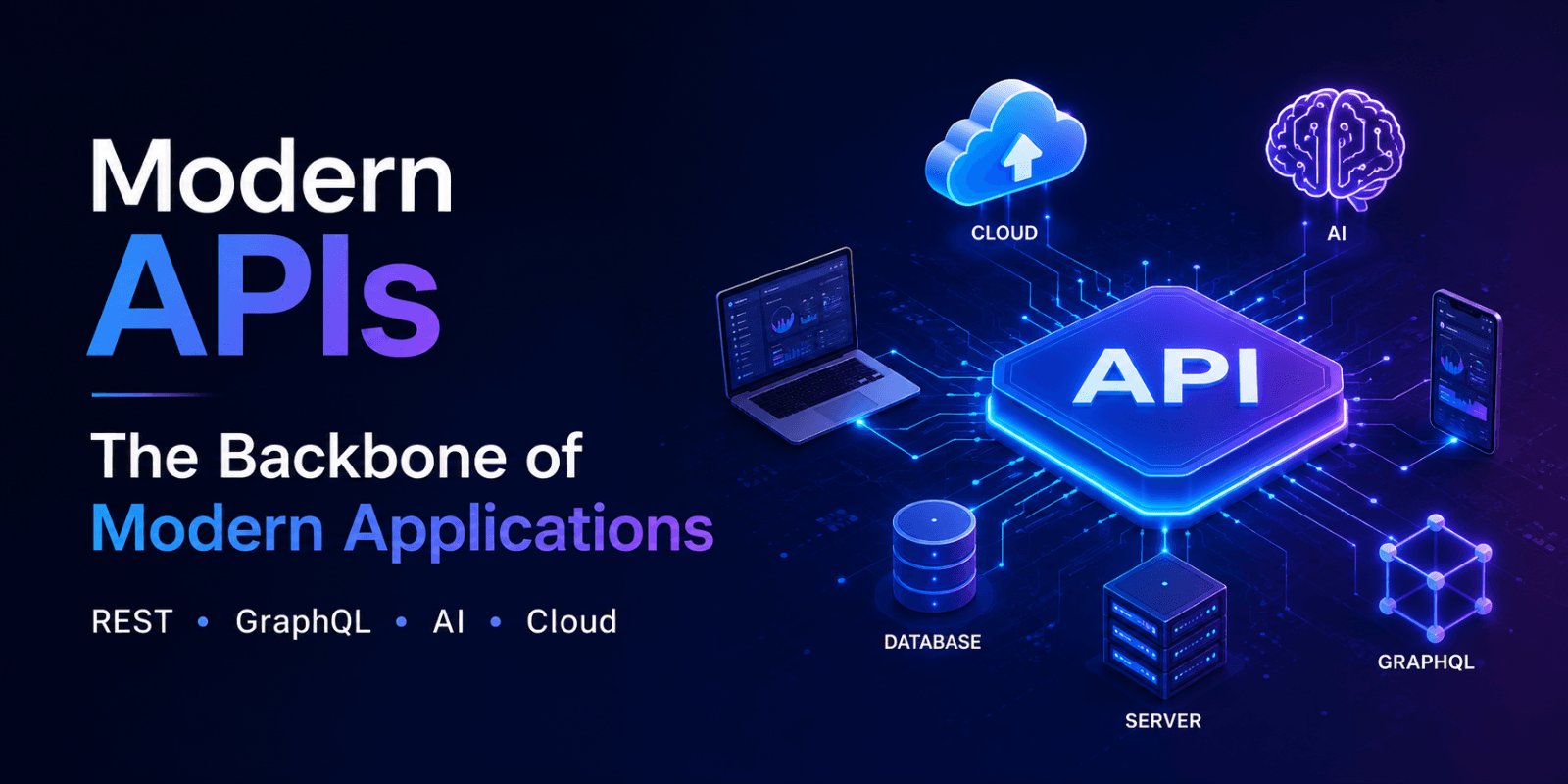
Learn what APIs are, how they work, why modern applications depend on them, and how APIs power websites, mobile apps, cloud platforms, and AI systems.
Why APIs Are the Backbone of Modern Applications: Everything You Need to Know
Every time you book a ride through a mobile app, make an online payment, sign in with Google, check the weather on your smartphone, or ask an AI assistant a question, an API is working behind the scenes. Although most users never see them, Application Programming Interfaces (APIs) power nearly every digital experience we rely on today.
Modern software is no longer built as isolated applications. Instead, websites, mobile apps, cloud platforms, payment gateways, AI services, and enterprise systems constantly exchange information with one another. APIs make this communication possible by allowing different software systems to securely share data and functionality.
Instead of building every feature from scratch, developers integrate APIs to accelerate development, improve scalability, and create better user experiences. From startups to global enterprises, APIs have become one of the most valuable building blocks in modern software architecture.
In this guide, you’ll learn what APIs are, how they work, the different types of APIs, real-world examples, and why they are essential for modern web, mobile, cloud, and AI applications.
⸻
What Is an API?
An Application Programming Interface (API) is a set of rules and protocols that allows two or more software applications to communicate with each other.
Think of an API as a waiter in a restaurant.
The process works like this:
The waiter doesn’t cook the food—they simply enable communication between you and the kitchen.
Similarly, an API doesn’t create data itself. Instead, it acts as a messenger that sends requests from one application to another and returns the response.
For example, when you log into a website using your Google account, the website communicates with Google’s authentication servers through an API. Within seconds, Google verifies your identity and sends the result back to the application.
Without APIs, every application would need to build its own authentication, payment processing, mapping, messaging, and countless other services from scratch.
⸻
Why Do Modern Applications Need APIs?
Modern software rarely works in isolation.
Today’s applications continuously communicate with external platforms and services.
Examples include:
Imagine building an eCommerce website.
Instead of creating your own payment infrastructure, mapping system, email service, and SMS gateway, you simply integrate APIs from trusted providers.
For example:
This dramatically reduces development time while improving reliability and security.
APIs also enable businesses to adopt new technologies quickly without replacing their existing software infrastructure.
⸻
How an API Works
Although APIs seem complex, the basic communication process is straightforward.
Whenever a user performs an action inside an application, the following sequence typically occurs:
User Clicks a Button
↓
Application Sends API Request
↓
Server Processes the Request
↓
Database Retrieves Data
↓
Server Returns Response
↓
Application Displays Results
Let’s consider a real-world example.
Suppose a user opens a weather application and searches for “London.”
The application sends an API request to a weather service.
The weather provider retrieves the latest forecast from its servers and returns information such as:
The mobile application then displays the information in a user-friendly interface.
This entire process usually completes within a few hundred milliseconds.
⸻
Types of APIs
Modern software development uses several different API architectures.
Each is designed for different use cases.
REST API
Representational State Transfer (REST) is the most widely used API architecture.
REST APIs communicate using standard HTTP methods such as GET, POST, PUT, PATCH, and DELETE.
Advantages include:
REST APIs are commonly used for:
Because of their simplicity and flexibility, REST APIs have become the default choice for most modern web applications.
⸻
GraphQL API
GraphQL was introduced to solve limitations found in traditional REST APIs.
Instead of returning fixed datasets, GraphQL allows clients to request exactly the information they need.
Benefits include:
GraphQL is particularly useful for complex applications where different screens require different data structures.
⸻
WebSocket API
Unlike REST APIs, which follow a request-response model, WebSockets provide continuous, two-way communication between clients and servers.
This makes them ideal for real-time applications.
Common use cases include:
Because data flows continuously, users receive updates instantly without refreshing the page.
⸻
SOAP API
Simple Object Access Protocol (SOAP) is one of the oldest API standards still in use.
Although newer technologies like REST have become more popular, SOAP remains important in industries requiring strict security, reliability, and standardized communication.
SOAP is commonly used in:
Organizations handling highly sensitive transactions often continue using SOAP because of its strong security and compliance capabilities.
⸻
Common API Methods
REST APIs rely on standard HTTP methods to perform different actions.
The most common methods include:
Method Purpose
GET Retrieve information
POST Create new resources
PUT Replace existing resources
PATCH Update part of a resource
DELETE Remove resources
For example:
These standardized methods make APIs consistent and predictable across different applications.
⸻
Real-World API Examples
You interact with APIs every day, often without realizing it.
Google Maps API
Provides:
Thousands of ride-sharing, delivery, and travel applications rely on Google Maps APIs.
⸻
Stripe API
Stripe enables businesses to:
Instead of building complex payment infrastructure, developers integrate Stripe’s API in just a few steps.
⸻
OpenAI API
The OpenAI API allows developers to integrate advanced AI capabilities into their applications.
Businesses use it for:
This enables organizations to build AI-powered applications without developing machine learning models from scratch.
⸻
Firebase API
Firebase provides APIs for:
Many startups rely on Firebase to accelerate mobile and web application development.
⸻
Weather APIs
Weather APIs provide real-time environmental information including:
Travel applications, agriculture platforms, logistics companies, and event organizers depend on weather APIs to make informed decisions.
Modern software ecosystems are built on thousands of interconnected APIs working together behind the scenes. Whether you’re ordering food, booking flights, shopping online, or interacting with AI-powered tools, APIs make these digital experiences possible by enabling secure, fast, and reliable communication between systems.
⸻
Benefits of Using APIs
APIs have transformed the way software is built by allowing applications to reuse existing services instead of developing every feature from scratch. This approach accelerates development, reduces costs, and creates better digital experiences for users.
Some of the biggest benefits of APIs include:
Faster Development
Instead of building complex systems such as payment processing, authentication, or mapping from scratch, developers can integrate trusted APIs in a matter of hours or days.
This significantly shortens development cycles and allows teams to focus on creating unique business value.
⸻
Reusable Functionality
One API can serve multiple applications across different platforms.
For example, the same authentication API can be used by:
Reusable APIs improve consistency while reducing maintenance costs.
⸻
Better Scalability
As businesses grow, APIs make it easier to add new services without redesigning the entire application.
Organizations can integrate:
This modular architecture allows software to evolve alongside business requirements.
⸻
Easier System Integration
Modern businesses use dozens of software platforms.
APIs enable seamless communication between systems such as:
Without APIs, these systems would operate independently, resulting in duplicated work and inconsistent data.
⸻
Improved User Experience
Users expect modern applications to work quickly and seamlessly.
APIs enable:
These capabilities improve customer satisfaction and increase engagement.
⸻
Reduced Development Costs
By leveraging existing APIs, organizations avoid spending time and resources building features that already exist.
This reduces:
Businesses can launch products faster while staying within budget.
⸻
API Security Best Practices
Because APIs exchange sensitive information, security should be a top priority.
Organizations should follow these best practices.
Always Use HTTPS
HTTPS encrypts data while it travels between applications.
Encryption protects user information from interception and tampering.
⸻
Use Authentication
Authentication verifies the identity of users and applications.
Common authentication methods include:
Only authorized users should be able to access protected resources.
⸻
Implement Rate Limiting
Rate limiting prevents abuse by restricting the number of requests a client can make within a specified time.
Benefits include:
⸻
Validate Input
Never trust incoming data.
Always validate:
Input validation reduces security vulnerabilities such as SQL Injection and Cross-Site Scripting (XSS).
⸻
Monitor API Activity
Continuous monitoring helps detect unusual behavior and security threats.
Organizations should log:
Monitoring improves both security and reliability.
⸻
APIs and Artificial Intelligence
Artificial Intelligence has dramatically increased the importance of APIs.
Rather than building complex AI models internally, businesses now integrate AI capabilities through APIs.
Popular AI-powered services include:
For example, developers can integrate an AI API to automatically:
This makes advanced AI accessible to businesses of all sizes.
⸻
Common Challenges
Although APIs simplify software development, they also introduce several technical challenges.
Version Management
As APIs evolve, older applications may continue relying on previous versions.
Maintaining backward compatibility is essential for preventing disruptions.
⸻
Authentication Complexity
Managing authentication across multiple systems can become challenging.
Developers must carefully implement secure authorization mechanisms while ensuring a smooth user experience.
⸻
Performance Bottlenecks
Slow APIs negatively impact application performance.
Common causes include:
Optimizing API performance is critical for maintaining responsive applications.
⸻
Third-Party Dependencies
Many businesses rely on external APIs.
If a third-party service experiences downtime, your application may also be affected.
Organizations should always plan for service interruptions by implementing retries, fallbacks, and monitoring.
⸻
Rate Limits
Many public APIs limit the number of requests applications can make.
Developers should:
Efficient API usage improves reliability while reducing costs.
⸻
Best Practices for API Development
Building reliable APIs requires thoughtful design and ongoing maintenance.
Recommended best practices include:
Well-designed APIs are easier to maintain, integrate, and scale.
⸻
Why APIs Matter for Businesses
APIs are no longer just developer tools—they have become strategic business assets.
Organizations use APIs to:
Businesses that embrace API-first development can innovate more rapidly while remaining flexible in an increasingly connected digital world.
⸻
How MYST International Helps Businesses Build API-Driven Solutions
At MYST International, we develop secure, scalable, and high-performance API solutions that power modern digital products.
Our expertise includes:
Whether you’re building a web application, mobile app, SaaS platform, or AI-powered solution, our team designs APIs that are reliable, scalable, and future-ready.
⸻
Related Articles
⸻
Frequently Asked Questions
What is an API?
An API (Application Programming Interface) is a communication interface that allows different software applications to exchange data and functionality securely.
Why are APIs important?
APIs enable applications to connect with external services, automate workflows, improve scalability, and deliver seamless digital experiences.
What is the difference between REST and GraphQL?
REST provides predefined endpoints for accessing resources, while GraphQL allows clients to request exactly the data they need, reducing unnecessary data transfer.
Are APIs secure?
Yes. APIs can be secured using HTTPS encryption, authentication, authorization, input validation, rate limiting, and continuous monitoring.
Can small businesses benefit from APIs?
Absolutely. APIs allow small businesses to integrate payment systems, AI services, customer communication tools, cloud platforms, analytics, and marketing software without building these capabilities from scratch.
⸻
Final Thoughts
APIs are the invisible technology powering almost every modern digital experience. From websites and mobile applications to cloud platforms and artificial intelligence systems, APIs enable software to communicate efficiently, securely, and at scale.
As businesses continue adopting cloud computing, AI, IoT, and microservices, APIs will become even more essential. Organizations that embrace API-first development can innovate faster, integrate new technologies with ease, and build scalable digital products that adapt to changing business needs.
Whether you’re developing your first web application or building an enterprise platform, understanding APIs is a fundamental skill that empowers developers and businesses to create connected, future-ready software.
An API is a communication interface that allows different software applications to exchange data and functionality.
APIs enable applications to connect with external services, automate workflows, and deliver modern digital experiences.
REST provides fixed endpoints, while GraphQL allows clients to request exactly the data they need.
Yes. APIs can be secured using HTTPS, authentication, encryption, rate limiting, and proper authorization mechanisms.
Absolutely. APIs help businesses integrate payment gateways, customer communication tools, analytics, AI services, and cloud platforms without building everything from scratch.